

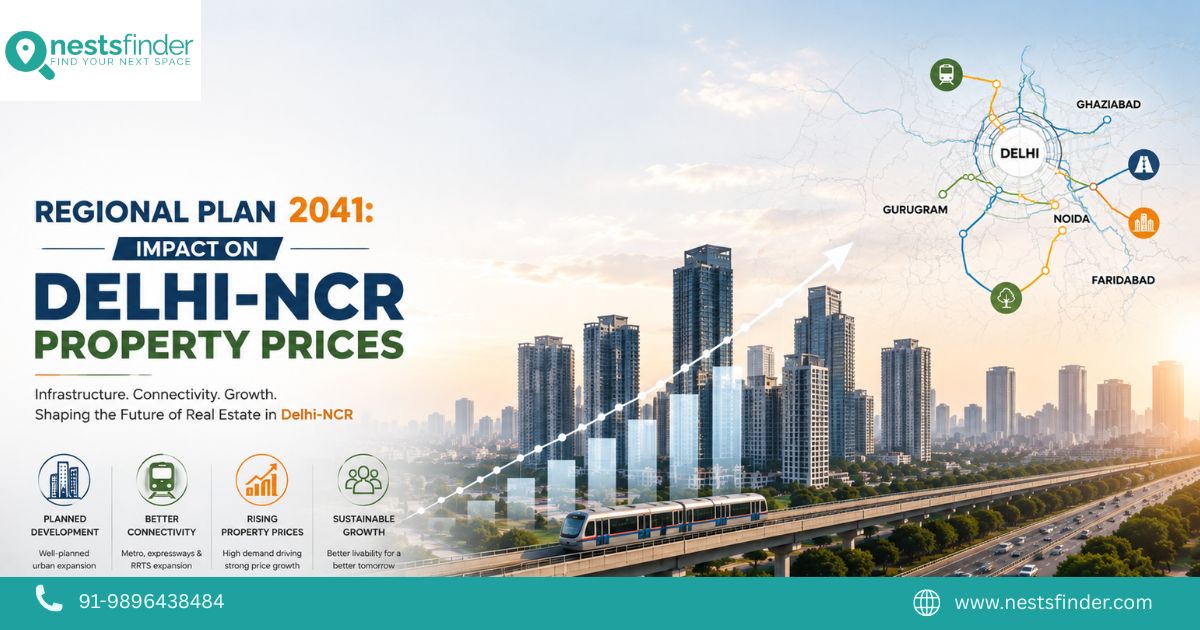

Regional Plan 2041: Impact on Delhi-NCR property prices
Regional Plan 2041 is a long-term development strategy prepared under the National Capital Region Planning Board 2041 (NCRPB), covering 55,000 square kilometres. Its objective is to ensure the planned and balanced development of the National Capital Region (NCR) by the year 2041. The vision of Regional Plan 2041 is to reduce the pressure on Delhi and create economic growth centres in the surrounding cities. Under this plan, there will be no change in the boundary of the NCR.
What is Regional Plan 2041
The 42nd meeting of the National Capital Region Planning Board (NCRPB) was held in New Delhi on 16 June 2026.During the meeting, the Regional Plan 2041 was discussed in detail, and several important decisions were taken. The meeting was chaired by Shri Manohar Lal, Union Minister for Housing and Urban Affairs, and Shri Jhabar Singh Kharra, Rajasthan’s Minister for Urban Development, also participated.
A sub-committee of senior officials from the Central Government and the NCR states was constituted to submit its final report by 15 August. After that, the plan will be sent to the Ministry of Housing and Urban Affairs (MoHUA) for approval, and it will be implemented after receiving approval from the Ministry. NCRPB is a statutory body working under the Ministry of Housing and Urban Affairs (MoHUA), Government of India.
Regional Plan 2041 is a long-term strategic blueprint that manages the entire NCR’s land use, infrastructure, housing, transport, smart digital technology, and environment.The objective of introducing this plan is to manage the growing population of the NCR through proper planning. According to the current figures, the population of the NCR is 7.86 crore, which is estimated to increase to 11 crore by 2041.
Regional Plan 2041 is not only for Delhi-NCR, but it also impacts the surrounding larger region, which will lead to the development of economically prosperous areas.Under this plan, four states connected to the NCR have been included and have been named Namo Cities. These include Haryana, Rajasthan, Uttar Pradesh, and Delhi. For the development of each, the government has allocated a budget of ₹5,000 crore.
Four Greenfield “Namo Cities
Under the Regional Plan 2041, the government is developing four new greenfield Namo Cities to reduce the growing population pressure on Delhi.Namo City is based on the concept of mixed-use development. Under this, high-speed public transport, residential projects, and commercial facilities will be developed together in one place. This will encourage people to use private vehicles less, while also promoting employment. Along with better connectivity, it will enhance the quality of life.
- Delhi: To reduce the pressure of the growing population, some areas will be selected for Namo City where there are green zones and more land Modern development and all facilities will be provided there, which will attract people to migrate there, reducing the population pressure. It will be connected to the Namo Bharat (RRTS) network. The Central Government will provide that state with a budget of ₹5,000 crore for the development of that area.
- Haryana: In Haryana, the RRTS, expressways, and industrial corridors will create a new hub of development. The discussed areas include Sonipat, Panipat, and Gurugram, but no confirmation has been made yet regarding which area will become Namo City. The Central Government will provide a budget of ₹5,000 crore to Haryana to promote the development of Namo City, through which complete development will be carried out.
- Uttar Pradesh: : In Uttar Pradesh, Namo City is likely to be developed around Noida and Jewar, but the final location has not been decided yet. Its objective is to promote investment, as well as provide new housing and employment. Namo City will have all the facilities that a metro city has.
- Rajasthan: : It is proposed to promote the development of the NCR region. Some areas of Rajasthan, such as Bhiwadi and Alwar, are under discussion. The area that is closest to Delhi will be selected. The focus will be on industrial investment and balanced regional development. The Central Government will provide a budget of ₹5,000 crore for the development of Namo City so that there is no obstacle in the development.
Key objectives of the plan
- Under the Regional Plan 2041, there will be very good transport facilities through the 30-Minute NCR Connectivity This will encourage the growing population to use public transport instead of private vehicles, and travel between Delhi and the major cities of NCR through high-speed rail will be possible within 30 minutes.
- Under the New Urban Centre, a greenfield area will be developed through four Namo Cities, which will help reduce the pressure of the growing population. At the same time, there will be balanced development of economic and industrial opportunities.
- Under the Environmental Sustainability plan, the government has made strict land use rules to protect the environment, so that urban development takes place while large green areas are also protected, so that the environment is not harmed.
- Under Transit-Oriented Development, mixed-use development will be focused around public transport stations so that people can easily access both employment and housing.
How Regional Plan 2041 could Impact Delhi-NCR Property price
Under this plan, there is a possibility of a very significant and deep impact on the Delhi-NCR property market. because this plan focuses on better connectivity, transport, infrastructure, high-speed transport, and new cities. Due to the planned development, residential and commercial property prices are expected to increase
Infrastructure & Connectivity
Regional Plan 2041 will expand expressways, metro networks, highways, and other transportation facilities.With NCR within a 30-minute distance and better road transportation facilities, residential property prices are expected to increase because where connectivity is good, the chances of land prices rising are much higher. Therefore, there is an expectation that land prices will increase in the future in the areas developed under this plan.
Demand & Supply
The objective of this plan is to settle the growing population of NCR in a planned manner by the year 2041. When employment, education, healthcare services, and infrastructure facilities develop, more homebuyers will be attracted and the demand for land will increase. On the other side, when the government and private developers develop new areas, townships, and gated societies, the supply in the market will also increase, and a rise in property prices may be seen.
Residential & Commercial
The biggest and most positive impact of this plan can be seen in Delhi’s real estate. Modern development, public transport, and better facilities increase the demand for residential land. The availability of all facilities, gated societies, and employment opportunities in a developed area can increase the number of residential buyers. On the other hand, if commercial property is considered, all facilities and industrial development can make new areas commercial hubs. As development increases employment, the value of nearby properties will easily increase, especially the land located near RRTS stations and expressway corridors is expected to increase in price.
Which Location are Benefit For Delhi-NCR Investors
After the implementation of Regional Plan 2041, investors are likely to receive good high returns from investing in property. Due to modern development and new employment opportunities, investors will be attracted.In the future, the demand and prices of real estate will increase, so investors will give it higher priority and can earn profits.
Dwarka Expressway (Gurugram & Delhi)
Gurugram is the main real estate and corporate hub of Delhi-NCR. The Dwarka Expressway provides faster and better connectivity to Indira Gandhi International Airport. This will promote new businesses and also create employment opportunities for people. In the future, the prices of land along the expressway are likely to increase significantly. Therefore, it is considered a better option for long-term investment.
Yamuna Expressway / Jewar
Due to Noida International Airport, industrial projects,and logistics hubs, the areas along this expressway are developing rapidly. This is attracting investors. Land and constructed houses here are still affordable. In the future, they can provide investors with profits through better price appreciation.The possibility of long-term capital gains is an attractive option for investors.
Noida-Greater Noida Expressway
Better road infrastructure, metro connectivity, Noida IT parks, MNCs, and educational institutions have made this a good investment option for investors. Developed areas like Sector 150, with luxury housing and higher rental demand, make investment more profitable.
New Gurugram
New Gurugram is now a rapidly developing residential area. It has good connectivity through major roads such as Dwarka Expressway, NH-48, and SPR.Large townships, corporate developments, and good social infrastructure can provide investors with high returns in the future.
Conclusion
Regional Plan 2041 will prove to be a good plan for the growing population of Delhi-NCR and for shaping its future economic growth. Better connectivity, modern infrastructure, RRTS network, and all these facilities will be available in the proposed Namo Cities, which can have a positive impact on the NCR system and real estate in the coming years. This may increase the demand for residential, commercial, and land properties, and investors can earn good returns by investing in the developing areas.
Also check:
Impact of Delhi-Dehradun expressway on property price in Dehradun